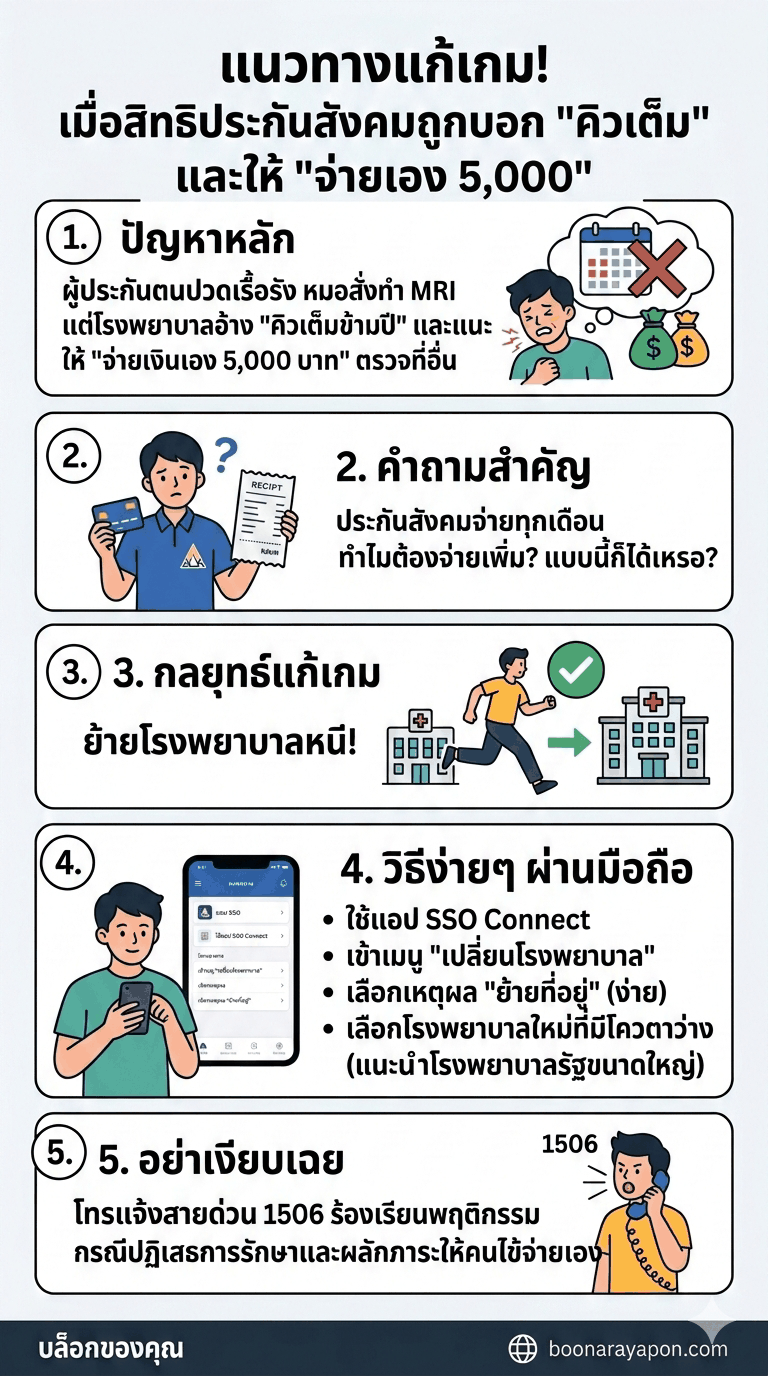
Translated from the original Thai Facebook post:
"I have a story to share. It's about someone I know. They went to their registered SSO hospital — a private clinic near Bang Bon — for chronic neck and shoulder pain with arm pain. The doctor X-rayed and diagnosed cervical disc degeneration. They've been getting treatment there for a year, taking medication. Recently the pain came back. The doctor ordered an MRI — but told them the queue at this hospital is full until next year. Go get the MRI done at another hospital, then bring the results back here. The person followed the doctor's advice, went to another hospital, and paid 5,000 THB out-of-pocket."
"I want to ask — is this actually allowed? It feels like a polite refusal by a doctor who seems reputable but doesn't want to deal with ordering the MRI at their own hospital. It doesn't seem fair that we have to pay into social security every month and then also pay out-of-pocket for tests. Or does social security not cover MRI at all? I'm confused and wanted to share — if anyone has information or advice, please let me know. Thank you."
🔬 Analysis: Is This a Stealth Refusal?
The hospital never said "we won't treat you." But setting a year-long queue while offering a paid fast-track at another hospital is a form of implicit access denial — a practice that shifts costs from the hospital's SSO contract onto the patient. It's more common than people realize.
The core principle is simple: When a doctor determines an MRI is medically necessary, the contracted SSO hospital must arrange it at no extra cost to the insured person — either in-house, via a network referral, or by issuing a formal Referral Letter to another facility. The patient should pay nothing.
S.33
Employed workers,
monthly contributions
S.39
Voluntarily insured,
self-paid contributions
฿0
What you should pay
extra for an SSO MRI
⚠️ 3 Key Facts Every Insured Worker Should Know
Fact 1
The contracted hospital already receives SSO fund payments for your coverage. It is legally obligated to arrange all medically necessary services. If it cannot perform the MRI, it must issue a formal Referral Letter — at no cost to the patient.
Fact 2
"Queue is full, but pay 5,000 THB elsewhere" — without a written referral — is cost-shifting. It creates the false impression that the patient has no other option, while the hospital avoids its contractual responsibility.
Fact 3
If you have already paid out-of-pocket, you can claim reimbursement within 2 years by filing Form SSP 2-01 at your local SSO office, with a receipt and the doctor's note specifying the MRI was medically required.
Contracted Hospital = Already receives SSO fund payments
→ Must arrange MRI = Patient pays nothing extra
→ If can't do it → Must issue a formal Referral Letter
✅ Bottom line: You have the right to demand a written referral if your SSO hospital cannot provide timely care. If they refuse to issue one, you have grounds to file a complaint and claim reimbursement.
🏃 The Game-Changing Strategy: Switch via SSO Plus
The simplest and most effective path forward is to change your registered SSO hospital to a large public hospital with its own MRI equipment. This is done through the SSO Plus app (the updated name for SSO Connect) in under 2 minutes — no office visit required.
"Switching your SSO hospital is free, takes under 2 minutes on your phone, and can save you thousands of baht."
— Boon Arayapon, boonarayapon.com
📱 How to Switch via SSO Plus App (Step-by-Step)
Step 1: Download SSO Plus (iOS / Android) — or go to sso.go.th on web
Step 2: Log in with your 13-digit national ID number
Step 3: Go to "Change Hospital" / "Change Medical Facility" menu and select a reason
🔑 Key technique: Choose "Change of Residence" or "Change of Workplace" as the reason — these are approved via Self-Declaration, meaning no supporting documents needed
Step 4: Search for a large public hospital near you with available quota (recommended: provincial general hospitals or university teaching hospitals)
Step 5: Confirm — completely free of charge
The switch is not immediate — it depends on when you confirm:
🗓️ Confirmed on 1st–15th of the month → New coverage from the 16th of that month
🗓️ Confirmed on 16th–end of month → New coverage from the 1st of next month
The 5,000 THB saving strategy: Switch today → Wait for new coverage to activate → Bring your existing treatment records to the new hospital → Request evaluation and MRI referral based on medical indication
Based on widespread experience among SSO-insured workers, large public hospitals and university teaching hospitals tend to follow clinical indications more strictly than smaller private facilities. Even with higher patient volumes, their approval process for special diagnostics like MRI and CT scans is usually more standardized and transparent. Look for provincial general hospitals (โรงพยาบาลศูนย์), Ministry of Public Health facilities, or university-affiliated hospitals with on-site MRI machines.
Yes — file Form SSP 2-01 (Request for Benefits: Injury or Illness) with:
• Receipt for the MRI payment
• Doctor's note specifying MRI was medically necessary
• Copy of your national ID
Submit to your local SSO district office within 2 years of the payment date. Partial or full reimbursement is at the officer's discretion — but always file, as doing nothing guarantees nothing back.
⚖️ What Hospitals Must Do vs. What Actually Happened
⚖️ Correct Behavior vs. What Occurred in This Case
❌ Wrong
Verbally saying "queue full until next year" and suggesting the patient pay out-of-pocket elsewhere — without any written referral documentation
❌ Wrong
If the hospital says "machine is broken" or "queue is full" but provides no Referral Letter — the full cost burden falls on the patient with no documentation to claim reimbursement
✅ Correct
If the queue is genuinely too long, the hospital must issue a formal Referral Letter to a facility that can perform the MRI, and the originating hospital remains responsible for the cost — the patient pays nothing
📞 Don't Stay Silent — Report to Build a Record
Filing a complaint serves two purposes: it creates an official record that regulators can act on, and it protects future insured workers from experiencing the same cost-shifting behavior.
📞
How to File a Complaint
Hotline 1506 — Call Thailand's SSO 24/7. Provide the hospital name, date, and exactly what was said or suggested.
sso.go.th — File an online complaint via the "Complaint / Information" section on the SSO website.
SSO District Office — Visit in person with supporting evidence: receipts, conversation records, screenshots, or notes of what occurred.
❓ Frequently Asked Questions
What if the hospital says "the MRI machine is broken"?
Request a written referral letter and ask for a specific timeline in writing. Issuing a referral is the hospital's contractual obligation to SSO. If they refuse to provide one, call 1506 immediately to report the behavior.
Can I switch back to my original hospital later?
Yes — in the next change cycle. Switching back works exactly the same way as the initial switch: free, via SSO Plus, and subject to the same timing rules (confirmed 1st–15th → effective 16th; confirmed 16th–end of month → effective 1st of next month). There is no penalty for switching.
Will my treatment history transfer when I switch hospitals?
Your medical records stay at the original hospital. You can request a copy of your medical history — the hospital must provide it within 15 days by law. Bring a treatment summary, X-ray results, and current medication list to your first appointment at the new hospital. The new hospital starts fresh without prior records unless you bring them.
Does SSO Section 40 also cover MRI?
Section 40 insured persons have more limited healthcare benefits. Most general illness care for Section 40 workers falls under the Universal Healthcare (Gold Card / บัตรทอง) scheme via the NHSO, which also covers MRI when medically ordered. If unsure which scheme applies to you, call NHSO at 1330 or SSO at 1506 to verify your current rights.
Is there a fee to switch hospitals?
No fee whatsoever. Changing your registered SSO facility is a right that costs nothing — whether done through the SSO Plus app or in person at an SSO office.
✊ Your Rights. Your Money. Your Move.
An MRI is not a luxury — it's a medical service you are owed if your doctor says it's necessary. You contribute to social security every month. You should not have to pay again out-of-pocket. If this happens to you: demand a written referral first → switch hospitals via SSO Plus → call 1506 to report → share this so others know their rights too.
💚 Follow Dr. Boon on LINE
🇹🇭 อ่านบทความภาษาไทย
📞 Report to SSO: 1506