🏛️
Pratana Phodee
SSO Board Candidate No. 1 · Thai Government Contract Worker Network
Position
Chair, Thai Government Contract Worker Network (100,000+ members)
Mission
Register "Government Employee Association" — formal legal status for workers
Official Score (2026)
13,750 votes (Ranked 9th)
Actual Score (estimated)
~15,050 votes (Should have ranked 7th)
⚕️
Boon Arayapon
SSO Board Candidate No. 8 · Founder, boonarayapon.com
Role
Dr. Boon — Thailand's leading social security veterinarian-advocate
Known For
3-Kor Law · "Not Begging, Reclaiming" movement
🔍 The Vanishing Votes: When a Data Entry Error Almost Rewrote History
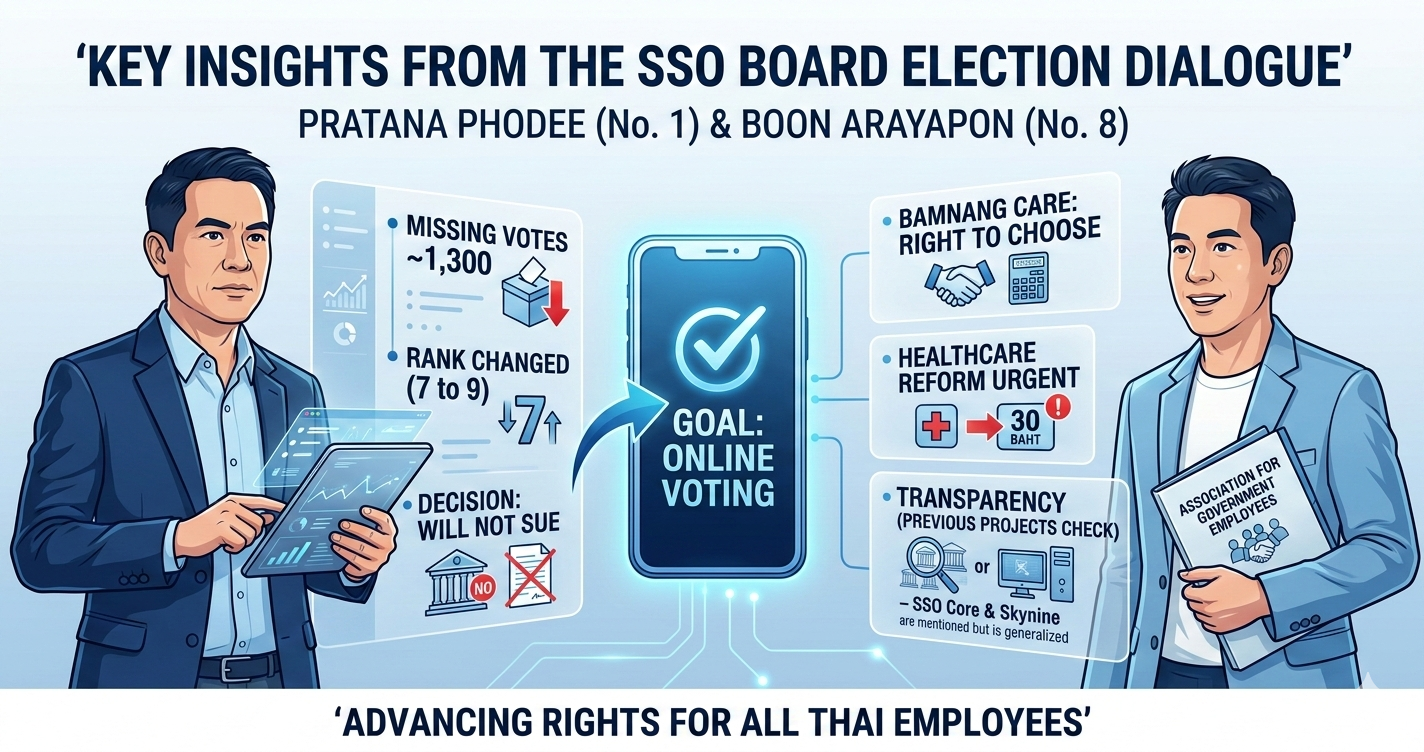
In the official results of Thailand's 2026 SSO Board election, Pratana Phodee — Chair of the Thai Government Contract Worker Network — appeared in 9th place with 13,750 votes. But a startling truth emerged in this conversation.
Thailand's SSO Board has 7 elected employee seats. Finish in the top 7, and you hold real power over a fund managing hundreds of billions of baht in retirement, healthcare, and unemployment benefits for nearly 25 million workers. Finish 8th or below, and you're out.
⚠️ What Really Happened: 1,300 Votes Disappeared
Cause
Human data entry error at the Min Buri district polling station (Lotus voting point) — approximately 1,300 votes were not counted in the official tally.
Confirmed By
The Social Security Office issued an official letter acknowledging the error.
13,750 (official) + 1,300 (missing) = 15,050 votes
What should have happened: With 15,050 votes, Pratana would have overtaken Jaturong Praisingha (7th place, 14,937 votes) — currently serving as interim SSO Board member — and secured a seat on the Board. Instead, a data entry error cost him a historic mandate.
13,750
Official votes
(Ranked 9th)
1,300
Missing votes
(Min Buri district)
15,050
True total
(Should be 7th)
📊 Official Results: Thailand's First-Ever SSO Board Election — December 24, 2023
The official score table from Thailand's historic first direct SSO Board election, where contributors voted for their representatives for the very first time. Boon Arayapon (No. 8) received 9,066 votes (18th place), while Pratana Phodee (No. 1) received 13,750 votes (9th place) — though as revealed in this interview, his true total should have been ~15,050 votes (7th place) had the Min Buri data entry error not occurred.
Official Document · Social Security Office Thailand
SSO Board Election Official Results
First-Ever Direct Election · December 24, 2023
⭐ Rank 9 = Pratana Phodee (No. 1) · Rank 18 = Boon Arayapon (No. 8) · Top 7 = elected to Board
💛 A Decision of Principle: "I Won't Sue — For the Sake of 24.9 Million Workers"
Despite holding an official SSO acknowledgment letter confirming the error, Pratana made a decision that surprised many: he chose not to file a case with Thailand's Administrative Court. Boon pressed him directly on this in their conversation.
🦅
Why He Chose Not to Sue
Filing an administrative court case against the election results in Thailand typically triggers a legal freeze on the Board's operations — meaning the newly elected Board (including other candidates who won fairly) would be unable to act on urgent reforms, investment decisions, or benefit improvements while the case drags on for months or years. Pratana calculated that the cost to 24.9 million workers would outweigh the benefit of reclaiming his seat. He chose to let the Board function — and continue the fight from outside.
"I have the right to sue. The evidence is clear. But if I file, the entire Board freezes. Workers lose. I chose the workers over my seat."
— Pratana Phodee, Chair, Thai Government Contract Worker Network
🏗️ The Next Mission: Building Legal Power for Contract Workers
Thailand employs a large but often overlooked segment of workers called พนักงานราชการ (Phanatgaan Ratchakaan) — government contract workers. Unlike permanent civil servants, they work for government agencies on fixed-term contracts, contribute to the SSO fund (not the civil servant pension fund), but enjoy far fewer protections and legal representation.
Pratana's network represents over 100,000 of these workers. But a network without formal legal registration has limited power at the negotiating table.
🎯 Plan: Register the "Government Employee Association"
Problem: The network currently lacks formal legal status, limiting its power to formally propose legislation or represent workers in legal proceedings.
Next step: Register as a formal "Government Employee Association" (สมาคมลูกจ้างภาครัฐ) with the Department of Provincial Administration.
Expected outcome: Legal standing to submit official bill proposals and formally represent contract workers before government agencies.
Long-term goal: Become the recognized voice for millions of contract and outsourced government workers in Thailand's social security policy discussions.
📋 Policy Flashpoints: Pensions, Healthcare Inequality & the CARE Formula
The conversation between Pratana and Boon surfaced two major structural problems that Thailand's SSO contributors face — issues largely invisible to the general public.
Background: Thailand's current SSO pension pays a flat rate regardless of how much a worker contributed over their career. The proposed CARE formula (Contribution-Adjusted Retirement Earnings) would link pension payouts to lifetime contributions — rewarding those who contributed more over more years.
Both Pratana and Boon support CARE's fairness logic. However, they insist it must come with a full opt-in/opt-out option — similar to Thailand's Government Pension Fund (GPF/กบข.) model — so that workers who contributed heavily under the old system aren't forced into a new formula without their consent.
Background: Thailand has three parallel healthcare systems: Civil Servant Medical Benefit, the Universal Coverage Scheme (the "30-Baht scheme"), and SSO healthcare. SSO contributors pay every month — yet Pratana revealed from real complaint cases that SSO cancer patients often receive worse drug coverage and less convenience than recipients of the free Universal Coverage Scheme. Workers are paying monthly, getting less. This contradiction is one of the most urgent equity issues in Thai social policy today.
⚖️ The Coverage Gap: SSO vs. Universal Coverage (for serious illness)
SSO (pays monthly)
≪
30-Baht Scheme (free)
Drug coverage breadth and hospital convenience for cancer treatment
Contributing worker
→
Should get more
Workers who contribute monthly to SSO are receiving less healthcare coverage than recipients of Thailand's free universal health scheme — a fundamental contradiction that the Board must address.
🗳️ The Future of SSO Elections: Online Voting Could Change Everything
In the 2026 election, SSO contributors had to physically travel to designated polling stations to cast their vote — a significant barrier for low-wage workers whose travel costs aren't reimbursed. Pratana proposed a structural solution with striking implications.
100K+
Network members
(Contract workers)
24.9M
Total SSO
contributors
Millions
Projected turnout
with Online Voting
"Most of our network are low-income contract workers. Traveling to a polling station just to cast one ballot is a real financial burden. If online voting existed, the turnout would transform Thai social security politics entirely."
— Pratana Phodee
For context: in the 2026 SSO Board election, total voter turnout was relatively modest given Thailand's 24.9 million eligible contributors. Online voting — already used in some Thai cooperative and union elections — could democratize participation dramatically.
❓ Key Questions Answered
How did 1,300 votes disappear in a government election?
A data entry error occurred at the Min Buri district polling station (Lotus shopping complex venue). Approximately 1,300 votes cast for Pratana Phodee were not entered into the official tally. The Social Security Office issued a formal letter confirming the error — but Pratana chose not to challenge the results in court to avoid disrupting the newly elected Board's work.
What is the SSO Board and why does it matter?
Thailand's SSO Board (คณะกรรมการประกันสังคม) is a 15-member body that governs the Social Security Fund — setting investment policy, determining benefit levels, and overseeing healthcare contracts for 24.9 million contributors. Seven seats are elected directly by workers (a historic reform first implemented in 2026). The Board controls hundreds of billions of baht in retirement and healthcare funds, making it one of the most consequential bodies in Thai labor policy.
What is the difference between SSO healthcare and the "30-Baht scheme"?
Thailand runs three parallel healthcare systems. The Universal Coverage Scheme (UCS), nicknamed the "30-Baht scheme," provides free healthcare for non-insured Thais (now effectively free). SSO healthcare covers private-sector workers through mandatory monthly contributions. Civil servants have their own scheme. The paradox: SSO contributors — who pay every month — sometimes receive worse cancer drug coverage than recipients of the free UCS, raising serious equity questions about the value of mandatory contributions.
What is the CARE pension formula?
CARE (Contribution-Adjusted Retirement Earnings) is a proposed pension reform that would calculate retirement payouts based on lifetime contributions rather than a flat rate. Supporters argue it's fairer for long-term contributors. Critics worry it disadvantages late-career workers or those with interrupted contribution histories. Both Pratana and Boon support CARE but insist it must be optional (opt-in) — not forced — similar to Thailand's Government Pension Fund (GPF/กบข.) model.
Who are government contract workers (พนักงานราชการ) in Thailand?
Thailand employs a large category of workers called Phanatgaan Ratchakaan — government contract workers who work for public agencies on fixed-term renewable contracts (typically 4 years). Unlike permanent civil servants, they contribute to the SSO (not the civil servant pension fund), have fewer job protections, and lack a formal union structure. There are estimated to be hundreds of thousands of them, and Pratana's network represents over 100,000 members in this group.
📣 Bottom Line: A Spirit Bigger Than the Scoreboard
Pratana Phodee may not have a seat on the 2026 SSO Board — taken from him by a data entry error he chose not to legally contest. But his decision to prioritize 24.9 million workers over personal ambition, his push to formalize legal power for contract workers, and his clear policy vision on pensions and healthcare make him one of the most important voices in Thailand's labor reform movement. Watch this space.
💚 Follow Dr. Boon on LINE
⚖️ What is the 3-Kor Law?