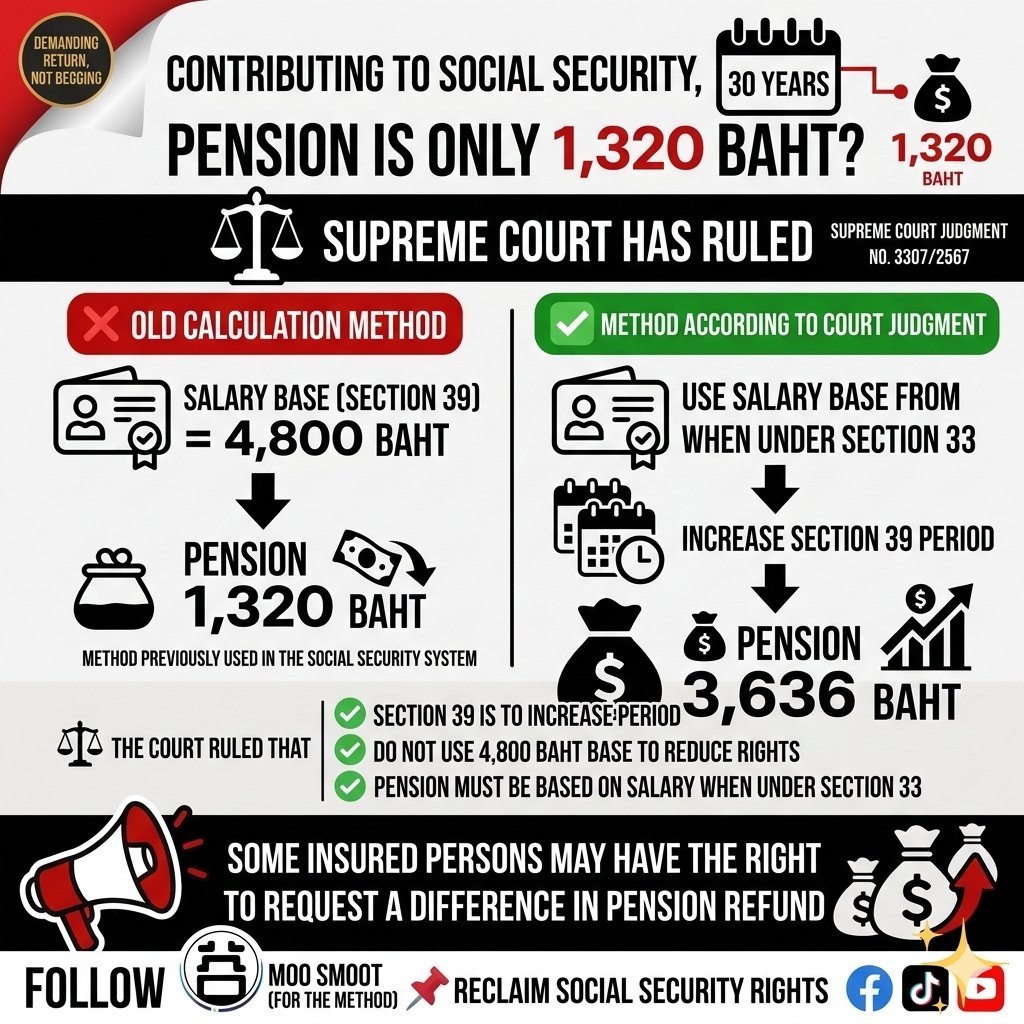
🚨 The Problem: Where Did 30 Years of Pension Go?
Millions of Section 39 (ม.39) insured persons in Thailand are unknowingly having their pension rights stripped away. The Social Security Office (SSO) takes the fictional 4,800-baht monthly base of Section 39 and averages it together with the real salary base from the Section 33 period within the final 60-month window. The result: a pension that should reach 15,000 baht/month is crushed to just 1,320 baht.
The problem isn't in the primary law itself — it's in the SSO's interpretation of subordinate regulations, which contradicts the fundamental purpose of Section 39: to let people preserve the rights they built up under Section 33, not diminish them.
⚠️ Real Example: 30 Years of Contributions → 60%+ Pension Loss
Old SSO Method
The 4,800-baht Section 39 base is averaged into the final 60-month window → the average salary drops dramatically → pension is slashed
60-month average (including Section 39 base) → Pension = 1,320 THB/month
Court-Correct Method
Uses the real Section 33 salary base + counts the Section 39 period to extend duration. The 4,800-baht base is NOT used to reduce the pension amount.
Section 33 salary base (real figure) → Pension = 3,636 THB/month
✅ Supreme Court Ruling 3307/2567: Section 39 is for extending the contribution period only — do NOT use the 4,800-baht base to reduce rights. Pension must be based on salary earned under Section 33.
1,320
THB/month
Pension actually received
(old SSO method)
3,636
THB/month
Pension rightly owed
(per Ruling 3307/2567)
+2,316
THB/month
Rights stripped from
each affected person
🛤️ Pathway 1: Labor Court — Fighting for Your Personal Rights
This route is for individuals who want to use their personal legal standing to force the SSO to recalculate their pension and pay back the shortfall. The key precedent is Supreme Court Judgment No. 3307/2567.
🏛️ Pathway 1 · Labor Court
Sue for Your Own Rights as an Individual
Step 1: File an appeal with the SSO's Appeals Committee within 30 days of receiving your pension statement.
Step 2: Once the SSO issues a rejection letter (which they typically do), take that letter and file a lawsuit at the Labor Court within 30 days.
Key legal argument: The SSO's use of the 4,800-baht base to reduce your pension contradicts the intent of the Social Security Act Section 39, which was designed to preserve or increase rights, not diminish them.
✅ If you win: The court orders the SSO to recalculate and pay the difference — but only to you, the plaintiff. The Labor Court ruling does not bind the SSO to change its calculation method nationwide. However, it sets an additional precedent and you recover your money.
"Section 39 was designed to let workers preserve the rights they built under Section 33 — using the 4,800-baht base to average down the pension directly contradicts this legislative intent."
— Boon Arayapon, analysis of Supreme Court Ruling 3307/2567
🏛️ Pathway 2: Supreme Administrative Court / Ombudsman — Changing the System for Everyone
This is systemic advocacy — fighting not just for yourself, but to break open the system for all affected Section 39 insured persons nationwide. The goal is to show that the Ministerial Regulation or operational guidelines the SSO relies on are unlawful under the primary statute.
⚖️ Pathway 2 · Supreme Administrative Court / Ombudsman
Strike Down the Interpretation — Win for Everyone
Supreme Administrative Court: Has authority to hear petitions to annul "regulations" — such as Ministerial Regulations or agency directives — that were issued unlawfully against the primary Act.
Parliamentary Ombudsman (ผู้ตรวจการแผ่นดิน): Citizens can collectively file complaints. If the Ombudsman finds a Ministerial Regulation is causing unjust harm and conflicts with the law, they can act as a representative to forward the matter to the Administrative Court or Constitutional Court.
✅ If you win: The Supreme Administrative Court issues an order to annul the regulation or interpretation — the SSO can no longer use the 4,800-baht base to reduce anyone's pension. The calculation system must be reformed for all insured persons nationwide.
⚖️ Core Legal Arguments for Both Pathways
Regardless of which path you choose, the following arguments form the legal backbone of this fight.
The Ministerial Regulation on the 60-month average wage calculation, when applied with the Section 39 base of 4,800 THB, strips away rights that insured persons accumulated over years of contributing. This conflicts with the Social Security Act (the higher-order primary law) and is therefore invalid to the extent of inconsistency.
Section 39 was legislated specifically to allow workers who leave employment to continue contributing and preserve their accrued pension entitlements. Any interpretation that results in a lower pension when a person contributes under Section 39 fundamentally contradicts this legislative purpose.
The SSO's blanket interpretation creates an unjust and discriminatory burden on those who chose to continue contributing in order to protect their rights. A person who kept contributing under Section 39 ends up with a lower pension than someone who simply stopped — a perverse outcome that violates principles of fairness and proportionality.
⚖️ Comparing the 2 Pathways: Which Should You Choose?
Labor Court
Faster Result
Outcome is personal — you recover your own money, but the SSO's nationwide practice remains unchanged. Good for immediate financial relief.
Admin Court
Systemic Change
Takes years, but a win reforms the entire system. The SSO must fix the calculation for every affected person in the country. The most impactful outcome long-term.
Both Together
Optimal Strategy
File at Labor Court for short-term personal recovery, while building political pressure to force a direct amendment of the Ministerial Regulation — far faster than waiting for the Administrative Court.
💡 Strategic Recommendations: How to Fight Effectively
While the Supreme Administrative Court pathway is the most definitive solution, it can take years. The most effective approach right now is to combine legal action with political and policy pressure simultaneously.
🎯 4-Step Strategy for Section 39 Victory
Build the Coalition: Create the largest possible network of affected persons to increase pressure and pool resources for litigation.
Use the Court Ruling as a Weapon: Cite Supreme Court Ruling 3307/2567 as the cornerstone reference in every channel — legal, media, and political.
Pressure the Minister and SSO Board: Demand that the Minister of Labour and the SSO Board directly amend the Ministerial Regulation. Executive action can fix this faster than waiting years for a court order.
Launch a Test Case: Find willing plaintiffs to file a landmark Labor Court case first, building statistical evidence and case law to support the Administrative Court petition.
🧮
Calculate Your SSO Pension First
Before deciding whether to pursue legal action, know exactly what your rights are worth. Use our SSO old-age pension calculator with 28 years of real Royal Gazette interest data.
🧮 Calculate My Pension
❓ Frequently Asked Questions
What must I do before I can file at the Labor Court?
You must first exhaust the SSO's internal appeals process by submitting an appeal to the SSO's "Appeals Committee" within 30 days of receiving your pension notification. Once the SSO issues a rejection letter (which they typically do), you can take that letter to the Labor Court and file within 30 days of the rejection date.
How does Supreme Court Ruling 3307/2567 help my case?
The ruling clearly established that Section 39 was designed to "extend the contribution period" only — the 4,800-baht base should not be used to reduce pension rights, and pensions must be calculated using the salary base from when the person was under Section 33. You can cite this ruling directly as precedent in Labor Court proceedings.
What is the Parliamentary Ombudsman (ผู้ตรวจการแผ่นดิน) and how do I file a complaint?
The Parliamentary Ombudsman is an independent constitutional body that investigates improper exercise of state power. Citizens can submit complaints directly to the Ombudsman's office (in person or online). If the Ombudsman finds that a Ministerial Regulation is causing unjust harm, they have the authority to refer the matter to the Administrative Court or Constitutional Court on behalf of the citizens — meaning you don't need to bear the full legal cost yourself.
If I win at the Labor Court, can I receive back-payment?
Generally yes — the court may order the SSO to pay the pension shortfall retroactively from the date you began receiving pension to the date of judgment, potentially with interest in some cases. The specific details depend on the facts of each case, so it's strongly recommended to consult a labour lawyer for individual advice.
Is there a faster solution that doesn't involve waiting years for a court?
Yes — if sufficient political pressure is applied, the Minister of Labour or the SSO Board can directly amend the Ministerial Regulation or issue new administrative guidelines, which is far faster than waiting for a court order. This is why collective action and lobbying politicians is just as critical as legal proceedings in this fight.
What is actually the right reason to enroll in Section 39?
The answer depends entirely on your personal goal — you need to ask yourself what you're trying to achieve.
If your goal is healthcare coverage: Section 39 is a solid choice. It lets you continue accessing SSO-covered hospital care after leaving employment, preserving medical benefits that would otherwise lapse.
If your goal is the highest possible pension: Under current law, the better path is to return to Section 33 coverage if at all possible. Section 33 uses your real salary (up to 15,000 THB) as the pension calculation base, giving you a significantly higher pension than Section 39's fixed 4,800-baht base.
If maximizing my retirement pension is the goal, what should I do?
Under current law, the clearest answer is: return to Section 33 if you can. Because Section 33 uses your actual salary (up to 15,000 THB/month) for pension calculation, the pension you build under it is substantially higher than anything Section 39's 4,800-baht base can produce.
If returning to Section 33 isn't possible, maintaining Section 39 is still better than stopping contributions entirely — but it's worth calculating your real numbers first using the SSO pension calculator before deciding.
How long does it actually take to get a law or policy changed?
You need to be realistic: it can take years, and some reforms may never happen. Legislative changes and Ministerial Regulation amendments both involve political processes with many competing interests.
The fastest practical path is pressuring the executive side — the Minister of Labour and the SSO Board — to directly amend the regulation. This bypasses parliament and can move much faster, but still requires enough sustained social and political pressure to make it happen.
How realistic is a class-action-style group lawsuit at the Administrative Court?
Highly promising — especially with enough participants. Supreme Court Ruling 3307/2567 only exists because one insured person had the courage to personally sue the Ministry of Labour. That single case became the landmark precedent everyone is now citing.
If thousands of insured persons unite to file a coordinated petition at the Administrative Court — arguing that the Ministry of Labour is misinterpreting the pension base regulation — the chances of winning, and winning faster, increase dramatically. Both the legal weight of the case and the social and political pressure it creates are multiplied when there are thousands of plaintiffs rather than one.