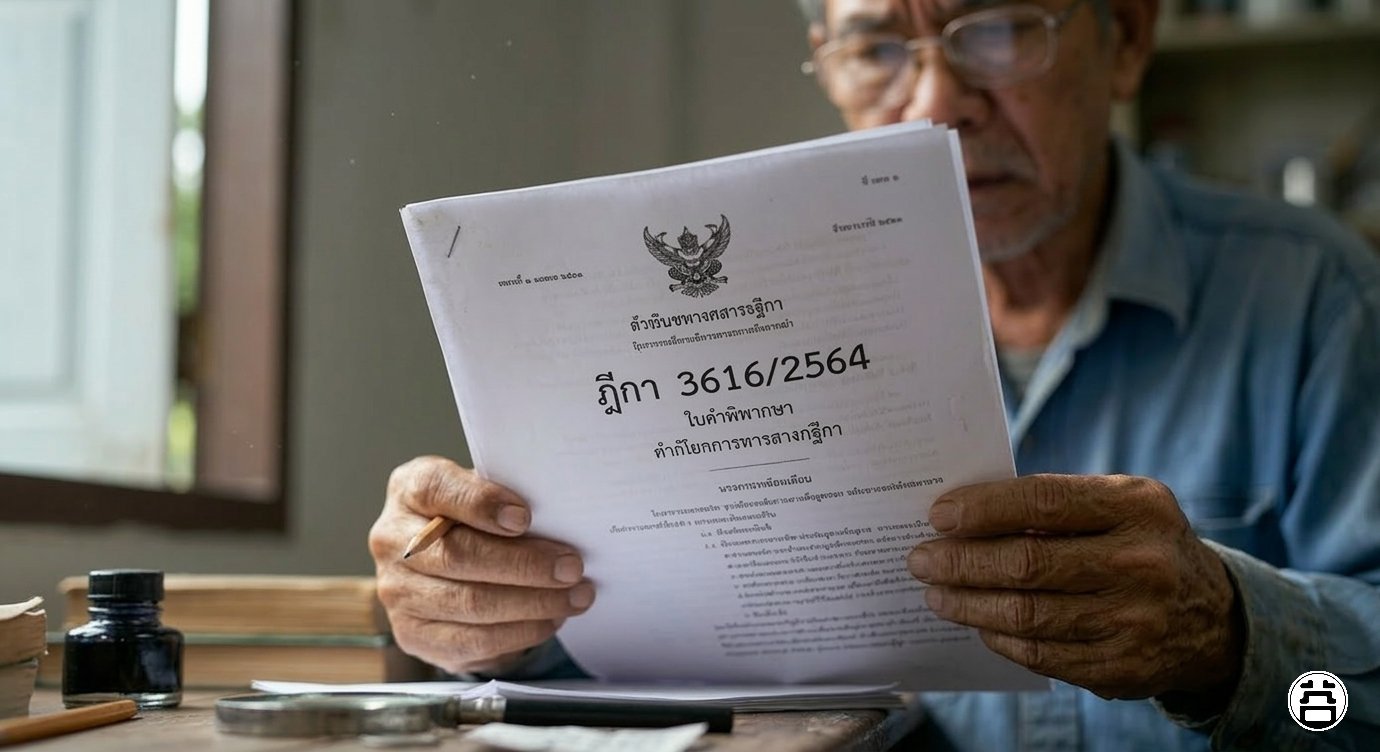
📜 Supreme Court Judgment
Case No. 3616/2564
Supreme Court — Labour Division · September 2, 2021
👷
Mr. Phairot Phiriyachat
PLAINTIFF · Worker who fought for a fairer pension
First contribution
March 1991 (Section 33)
Retirement months
188 months (old-age only)
Final status
Section 39 · 4,800 THB base
Monthly pension
1,164 THB / month
⚖️ Case Background: A Lifetime of Work, a Pittance in Retirement
Mr. Phairot began working and contributing to Thailand's SSO in 1991 under Section 33, the employer-employee contribution scheme. Over the decades, he switched between Section 33 (employed) and Section 39 (voluntary continuation) several times. In August 2016, he left the system entirely. In February 2017, he turned 55 and filed for his old-age pension.
The SSO in Pathum Thani Province assessed his pension at 1,164 THB per month. Mr. Phairot challenged this through the SSO appeal committee (dismissed), then the Central Labour Court (dismissed), the Specialised Court of Appeal (dismissed), and finally the Supreme Court — which also dismissed his case, confirming the SSO's method was legally correct.
⚠️ Why Does 30 Years of Work Equal Only 1,164 THB/Month?
Last 60 months
Section 39 base 4,800 THB × 54 months + Section 33 wage 15,000 THB × 6 months
(4,800 × 54) + (15,000 × 6)
────────────────────────────
60
= (259,200 + 90,000) ÷ 60
= 349,200 ÷ 60
= 5,820 THB (average wage)
💸 Monthly pension = 20% × 5,820 = 1,164 THB/month
Condition: 180+ months contribution → 20% base pension. But the Section 39 base drags the average way down.
4,800
THB/month
Section 39 fixed base
188
months of old-age
contributions paid
1,164
THB/month
pension received
📋 Three Legal Questions the Supreme Court Decided
The court's ruling on these three points has set binding precedent affecting all Thai SSO subscribers with mixed Section 33/39 histories:
The plaintiff argued counting should begin from his very first contribution in 1991. The court held that the Royal Decree of 1998 only started collecting old-age benefit contributions from December 31, 1998. Prior contributions covered other benefits only. Therefore Mr. Phairot's qualifying months are counted from 1998 — 188 months total, not from 1991.
The plaintiff argued that 4,800 THB is not a real wage and should not be used to calculate his pension. The court ruled that Ministerial Regulation No. 6 (1995) established this figure as the contribution base for Section 39 subscribers who have no employer, and it is to be treated as a "deemed wage" for pension calculation purposes.
The plaintiff wanted only his higher Section 33 wages used in the average. The court held that the law requires the average of all contribution bases across the final 60 months — both Section 33 actual wages and Section 39 deemed wages. Subscribers cannot selectively use only the figures that benefit them.
📜 The Court's Legal Principles (Ratio Decidendi)
The Supreme Court established three binding legal principles from this case that continue to govern SSO pension calculations today:
⚖️
3 Legal Principles from Case 3616/2564
① Old-age rights begin from the collection start date
The 180-month qualifying period for old-age benefits counts only from December 31, 1998 — the date the SSO began collecting old-age benefit contributions under the Royal Decree.
② The 4,800 THB Section 39 base = a "deemed wage"
Because Section 39 subscribers have no employer, the 4,800 THB set by ministerial regulation stands in place of an actual wage and must be used in pension calculations.
③ The 60-month average must include all statuses
Both Section 33 wages and Section 39 deemed wages are included in the 60-month average. Subscribers cannot selectively exclude periods that reduce their average.
"The calculation of the old-age pension must use the contribution base under which the subscriber was enrolled in each period — Section 33 or Section 39 — and not solely from Section 33 as the plaintiff argues."
— Supreme Court Case 3616/2564, paragraph 12 (translated summary)
🔍 Comparing Case 3616/2564 and Case 3307/2567
These two rulings are frequently cited together in Thai SSO reform discussions, but they serve very different roles:
| Dimension |
Case 3616/2564 (2021) |
Case 3307/2567 (2024) |
| Core message |
SSO's calculation method is lawful |
Questions the fairness of the system |
| Sec. 39 base |
4,800 THB = valid deemed wage |
Fairness of that figure debated |
| Effect on workers |
Low pension — but legally correct |
Catalysed reform advocacy |
| Significance |
Established precedent (still binding) |
Starting point for systemic change |
⚖️ What Case 3616/2564 Reveals About Section 39
Plaintiff's argument
Court's ruling
4,800 THB is not a real wage — but the court held it is a "deemed wage" by law, and must be used in calculations.
Use only Sec. 33 wages
Must include Sec. 39 base
Subscribers cannot cherry-pick only the periods that benefit them; all 60 months must be included.
Count from 1991
Count from Dec 31, 1998
Pre-1998 contributions did not cover old-age benefits — the scheme simply didn't exist yet.
💡 Policy Insight: The Law Was Correct, But the System Is Broken
Case 3616/2564 is not a case of judicial error — the court applied the law correctly. The problem is that the law itself creates structural unfairness for workers who transition from Section 33 to Section 39, particularly in their final working years.
🎯 Structural Problems This Case Exposes
The 4,800 THB base hasn't been updated: Set in 1995, it has never been adjusted for inflation or wage growth — despite minimum wages roughly tripling since then.
Section 39 is a trap for late-career transitions: Workers who lose employment and switch to Section 39 in their final years see their pension base collapse, regardless of decades of Section 33 contributions.
The "last 60 months" formula punishes career transitions: If your final years happen to be under Section 39, your entire lifetime of Section 33 contributions is overshadowed.
Dr. Boon's B60M proposal: Replace "last 60 months" with "best 60 months" from any point in the subscriber's career — a fairer formula that doesn't punish workers for late-career transitions.
📥 Download: Original Court Document (PDF)
This document was provided directly by Mr. Phairot Phiriyachat, the plaintiff in Case 3616/2564, who shared it with Dr. Boon for public education. It is made available here as a primary legal reference for researchers, advocates, and workers seeking to understand their rights.
📄
Supreme Court Judgment 3616/2564
Full text · Labour Division · September 2, 2021 · PDF (Thai language)
⬇️ Download PDF
❓ Frequently Asked Questions
What did Thailand's Supreme Court decide in Case 3616/2564?
Three things: (1) Old-age benefit counting starts from December 31, 1998, not the subscriber's enrollment date; (2) The 4,800 THB Section 39 contribution base is a valid "deemed wage" for pension calculation; (3) The 60-month average wage must include both Section 33 actual wages and Section 39 deemed wages — subscribers cannot use only the higher figures.
Why did Mr. Phairot receive only 1,164 THB monthly after decades of contributions?
Because 54 of his last 60 months as a subscriber were under Section 39, with its fixed 4,800 THB base. This pulled his 60-month average wage down from a potential 15,000 THB to just 5,820 THB. A 20% pension on that average equals 1,164 THB per month.
What is Section 39 of Thailand's Social Security Act?
Section 39 is a voluntary continuation scheme. Workers who leave employment (and lose Section 33 coverage) can pay contributions independently to keep their SSO benefits active. The contribution base is a fixed 4,800 THB/month, set by ministerial regulation in 1995 and never updated.
How does Case 3616/2564 differ from the more recent Case 3307/2567?
Case 3616/2564 confirmed the SSO's calculation methodology as legally correct under existing rules. Case 3307/2567 went further in questioning whether the system's structure is fair, and became the catalyst for the current pension reform movement, including Dr. Boon's B60M (Best 60 Months) proposal.
Is this ruling still in effect today?
Yes. The ruling remains binding because the underlying legislation and ministerial regulations have not been changed. The SSO continues to apply this methodology. Reform advocates including Dr. Boon are pushing for legislative changes to address the structural unfairness it reveals.
📣 The Law Was Applied Correctly — But the System Needs Reform
Case 3616/2564 shows that Thai courts follow the law faithfully. The problem is the law itself traps workers in an unfair system. That's why Dr. Boon is pushing for the B60M formula and the "3 Rights" Law — to fix the structure, not just the symptom.
💚 Follow Dr. Boon LINE
📊 What is B60M?
🇹🇭 Read in Thai