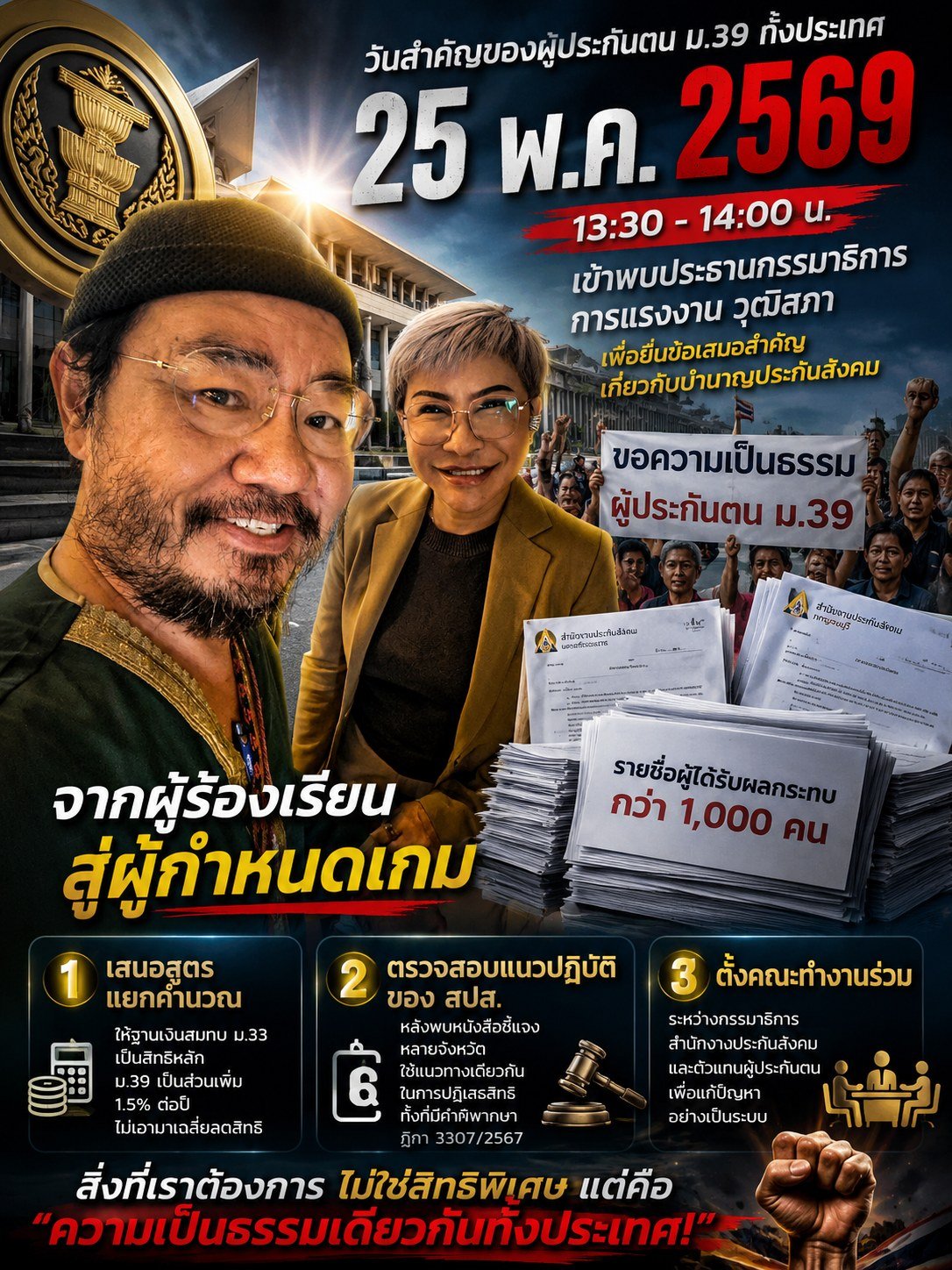
Meeting Counterpart · Senate Labour Committee Chair
Nirutti Sutthinon
Chair, Labour Committee of the Thai Senate — one of the few institutional actors with direct authority to
summon the SSO headquarters to explain its practices,
propose legislative amendments to the new Social Security Act,
and formally recommend ministerial review.
Six years of building evidence. 1,303 plaintiffs. Two identical rejection letters from opposite ends of the country.
On May 25, the movement brings all of it into the room where laws are made.
Why This Meeting Is Different from Everything Before
The "Khor Keun Mai Dai Khor Taan" movement has petitioned the Ministry of Labour,
marched on Channel 3, and filed with the Lawyers Council — each time receiving
either silence or a template rejection from the SSO.
The Senate Labour Committee is structurally different.
Nirutti Sutthinon, as committee chair, holds the institutional power to:
- Summon SSO headquarters for a formal explanation before the committee
- Propose legislative amendments (แปรญัตติ) to the new Social Security Act
- Formally recommend that the Ministry of Labour review its interpretation of Supreme Court Ruling 3307/2567
- Initiate a national public hearing on pension formula reform
None of the previous channels had these powers. The Senate committee does.
1,303
Registered plaintiffs with documented pension amounts
2 letters
Identical SSO rejections from South & Central Thailand — 48 hours apart
30 min
To present the case that could reshape 25 million workers' pensions
🗝️ The Evidence Entering the Room
1,303 named individuals from 38 provinces — each with documented pension amounts, contribution years, and the delta between what they receive and what they are legally owed.
Two identical rejection letters from Nakhon Si Thammarat (South) and Kanchanaburi (Central), dated 2 days apart, signed by different officials — proving a centrally directed national policy, not a provincial error.
Supreme Court Ruling 3307/2567 (2024) — the highest judicial authority in Thailand, already establishing that the CARE formula's use of the Section 39 ceiling to dilute Section 33 entitlements is unlawful.
The Three Legislative Proposals
1
Propose a "Separate Calculation" Formula Amendment to the New Social Security Act
The proposal: preserve the Section 33 contribution base (up to ฿15,000/month) as the primary pension entitlement, unaffected by the Section 39 transition. Section 39 contribution years would instead count as an additive rate of +1.5% per year rather than averaging down the existing entitlement.
Effect: A worker with 20 years in Section 33 and 5 years in Section 39 would receive a pension calculated on ฿15,000 plus 7.5% additional — instead of the current 70% reduction under CARE.
2
Summon SSO Headquarters to Explain Its National Rejection Policy
The movement holds documented evidence that the SSO issued a word-for-word identical rejection letter template to claimants in at least two provinces from opposite regions — demonstrating a centrally coordinated policy of denial.
The committee is asked to determine whether this practice aligns with the intent of Supreme Court Ruling 3307/2567, and to recommend that the SSO apply the ruling broadly without requiring individual litigation.
3
Establish a Joint 3-Party Working Group
A formal joint working group comprising the Senate Labour Committee, SSO headquarters, and insured persons' representatives — to review pension fund data, evaluate reform proposals, and develop a fair calculation methodology.
The inclusion of affected workers in this working group ensures transparency and direct accountability to those most impacted — not only to bureaucratic or actuarial interests.
Medium-Term Proposals
A
Retroactive Compensation Mechanism
Any legislative reform should include a mechanism for retroactive recalculation — compensating workers for the pension differential already lost since the CARE formula took effect, particularly following the Supreme Court's 2024 ruling.
B
National Public Hearing on Pension Reform
Request the Senate to convene a national public hearing giving workers, academics, and civil society organizations a formal platform to propose pension system reforms — moving beyond bilateral negotiation into genuine democratic participation.
C
Parliamentary Ombudsman Referral
If SSO continues to deny pension recalculations despite the Supreme Court ruling, request committee support for a formal referral to the Parliamentary Ombudsman, which can forward the matter to the Administrative Court as a systemic rights violation.
The 30-Minute Strategy
🎯 Proposed Meeting Structure
0–5
Present the scale: 1,303 names, 38 provinces, contribution histories, documented pension amounts — numbers that show this is not a fringe complaint but a systemic failure affecting millions.
5–10
Present the smoking gun: Two identical rejection letters, side by side, from opposite ends of Thailand, 48 hours apart. "If this was a provincial decision, why are the letters word-for-word identical?"
10–20
Present the three proposals clearly and concisely, grounded in Supreme Court Ruling 3307/2567 as the legal foundation for each request.
20–30
Request a written commitment on at least one concrete action — a scheduled SSO summons, a working group formation date, or a legislative amendment submission timeline.
What we want is not special privilege. It is equal justice — everywhere in Thailand.
— Boon Arayapon, D.V.M., LL.B. — Founder, "Khor Keun Mai Dai Khor Taan"
The Two Questions That Must Be Asked
👉 "The Supreme Court has already ruled. Why is your agency sending a template letter telling citizens to sue individually rather than applying the ruling broadly?"
👉 "Is the committee willing to formally summon SSO headquarters to explain this practice before a Senate session?"
The Room Is Set. The Evidence Is Ready.
Add your voice to the 1,303 — every testimony strengthens the case on the table.