30 Years of Thai Social Security — From Founding History to the 2026 CARE Pension Formula
Have you ever wondered what history the money deducted from your paycheque each month under "Social Security" has passed through? Why, in 2026, must salaried workers earning over 17,500 THB now pay up to 875 THB per month in contributions? And how exactly does the new pension formula called CARE revalue past wages? This article compiles a complete historical timeline, cross-checked against reliable sources at every point.

1. Foundations and Early Concepts (Before 1990)
Before becoming a welfare fund worth trillions of baht, Thailand went through nearly four decades of conceptual debate and legislative trial and error.
2. Dawn of the Modern Tripartite System (1990)
Labour movement momentum and political change under General Chatichai Choonhavan's government led to the birth of landmark welfare legislation.
Tripartite structure: Administered and co-funded by three parties — employees, employers, and government
Section 33: Initially mandatory for businesses with 20+ employees
4 initial categories: Sickness, maternity, disability, death
3. Three Decades of Frozen Ceilings and Expanding Coverage (1991-2025)
The table below shows the sequence of key events expanding benefits, while the contribution ceiling remained "locked" — with consequences that persist to this day.
| Year | Law / Event | Details and Structural Impact |
|---|---|---|
| 1994 | Social Security Act (No. 2) | Reformed the medical care system, expanded the network of contracted public and private hospitals |
| 1995 | Ministerial Regulation No. 7 | Birth of the historic 15,000 THB wage ceiling (max contribution 750 THB/month) — frozen for 30 years |
| 1998 | Birth of Section 39 | Allowed employees who left Section 33 jobs to continue contributing independently, preserving medical coverage |
| 1998 | Old-age contribution collection begins | Started deducting contributions to save toward a pension/gratuity fund (first cohort counted from December 1998) |
| 1999 | Social Security Act (No. 3) | Formally established old-age benefit rights; prepared for unemployment benefits |
| 2004 | Unemployment coverage begins | Added compensation for income loss due to termination or resignation |
| 2015 | Social Security Act (No. 4) | Major expansion to informal workers (Section 40); restructured the SSO Board to be elected |
4. The 2026 Reform Storm — Tiered Ceiling Increases
In 2026, the Social Security Office implemented its largest structural overhaul in three decades, addressing the fund's failure to reflect current living costs by scrapping the old 15,000 THB ceiling in favour of a three-phase structure (effective since 1 January 2026, per Royal Gazette announcement):
| Phase | Years | Wage Ceiling | Max Contribution |
|---|---|---|---|
| Phase 1 | 2026 – 2028 | 17,500 THB | 875 THB/month |
| Phase 2 | 2029 – 2031 | 20,000 THB | 1,000 THB/month |
| Phase 3 | 2032 onward | 23,000 THB | 1,150 THB/month |
Sources: Royal Gazette, Hfocus, Thailand Consumer Council
5. The CARE Pension Formula Crisis — What Does the Mechanism Actually Do?
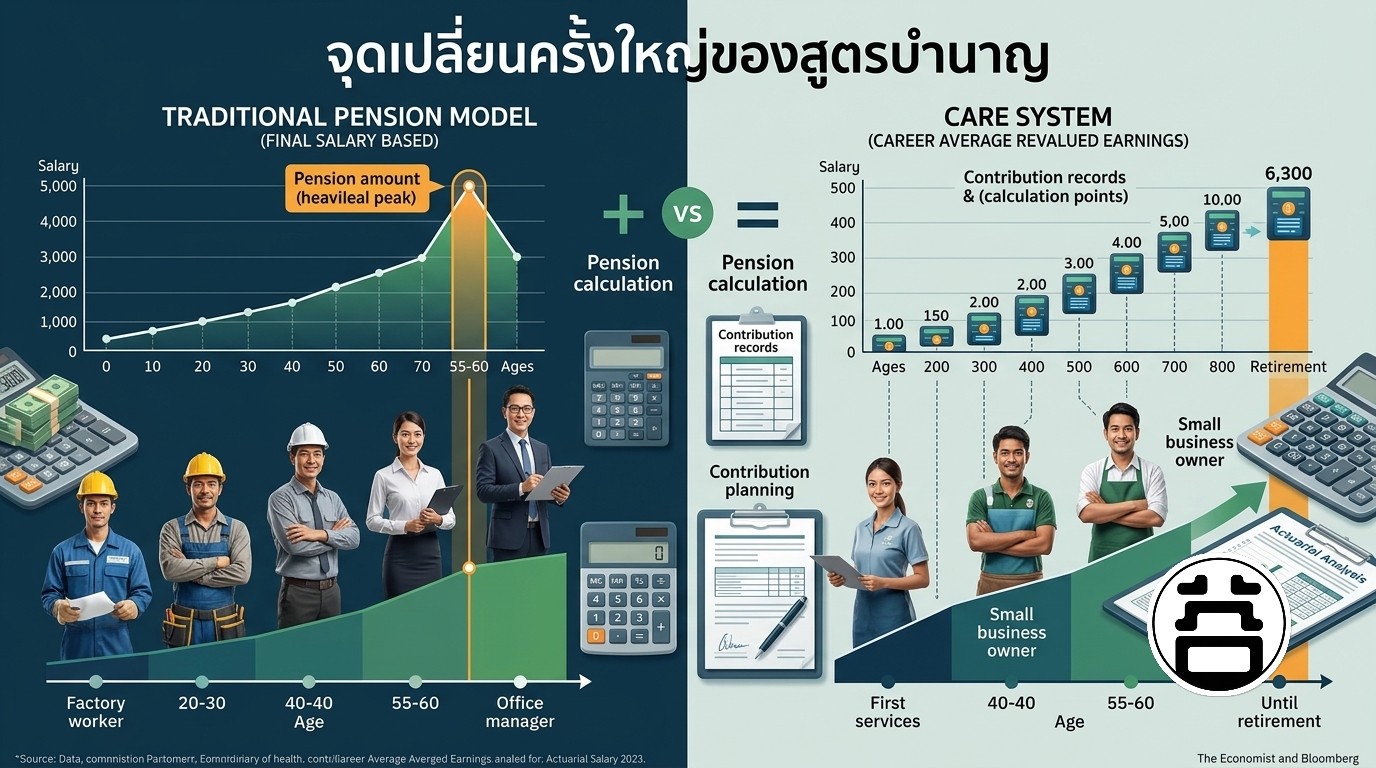
While the contribution ceiling increase has been broadly accepted, the real flashpoint has been the attempt to replace the traditional pension formula with CARE (Career-Average Revalued Earnings).
Comparing the Old Formula vs. CARE
- Traditional formula: Calculates pension from the average wage of the final 60 months before retirement — typically the peak-earning years of a career
- CARE formula: Calculates from the average wage across every contributing month of the entire career, converting each month's wage into "pension points" before averaging
The Real "Pension Points" Mechanism — Verified Against Multiple Sources
If your wage equals the system-wide average that month, you earn 1 point. Higher than average earns more than 1 point; lower earns less. Points accumulated over your entire working life are averaged, then multiplied by the wage base at the time your entitlement arises, to calculate your pension.
The "revaluation" mechanism in CARE compares each month's wage against the system-wide average wage — not the Consumer Price Index (CPI) or actual cost of living directly. These are not the same thing. If the system-wide average wage grows more slowly than real inflation (real wages stagnating while prices rise), there is no guarantee that a pension calculated on this basis will keep pace with the actual cost of living. This is a genuine structural risk insured workers should understand — not the claim that "there's no revaluation at all," which some sources overstate, but rather the more precise question: "revalued against what index, and does that index sufficiently reflect real living costs?"
The 5-Year Transition Compensation Mechanism
For fairness, the SSO stipulates that those retiring between 2026-2030 will have their pension calculated under both formulas for comparison. If the old formula yields more, the difference is compensated for life, tapering by retirement year:
| Retirement Year | Old Formula : CARE Ratio |
|---|---|
| 2025-2026 | 100% : 0% |
| 2027 | 80% : 20% |
| 2028 | 60% : 40% |
| 2029 | 40% : 60% |
| 2030 | 20% : 80% |
| 2031 onward | 0% : 100% (Full CARE) |
Sources: Thai PBS Policy Watch, Hfocus, Thai Rath
6. Current Legal Status — Correcting Misinformation
Some circulating claims allege that the CARE formula is currently being challenged at the Supreme Administrative Court — no evidence was found to confirm any such case as of July 2026. The real reason CARE and the new ceiling have not been fully implemented is political process — parliament was dissolved, and the caretaker government lacks authority to approve new regulations. The SSO expects implementation around mid-2026 once a new government takes office.
However, a genuine, related pension-rights case is ongoing — Supreme Court Ruling No. 3307/2024, which set precedent for separating the pension calculation base between Section 33 and Section 39, rather than averaging them at the lower base — this case underpins the ongoing Section 39 Class Action that Boon Arayapon and his team are pursuing.
Overstated claims (such as citing a lawsuit that does not exist) undermine the credibility of an otherwise legitimate campaign — the #StopCARE position has sufficient, verifiable grounds without needing to rely on exaggerated information.
7. Key Takeaways (Quick Summary)
- New contribution ceiling: 2026 raises the maximum wage base to 17,500 THB, max contribution 875 THB/month (only for those earning at or above the threshold)
- CARE pension points mechanism: Compares monthly wages against the system-wide average, not directly against inflation — real value may lag behind actual cost of living if system-wide wage growth is slower than inflation
- Legal status: CARE remains unimplemented due to political process, not a court order — the genuine related case is Supreme Court Ruling 3307/2024 on Section 33/39 base separation
8. Frequently Asked Questions (FAQ)
🗳️ For a Board That's Transparent and Genuinely Accountable
The 2.88-trillion-THB fund belonging to every insured worker needs a genuine guardian, informed by accurate data
⚖️ Section 39 Class Action Hub → 🏆 Full 7+1 Strategy Platform →