CARE: Whose "Fairness"?
The Questions Behind Thailand's New Pension Formula
When the word "academic" is used to lend legitimacy to a pension formula change, the important question isn't just how CARE calculates benefits. It's who designed it, who decides, and whether the public has actually seen the numbers from every side.
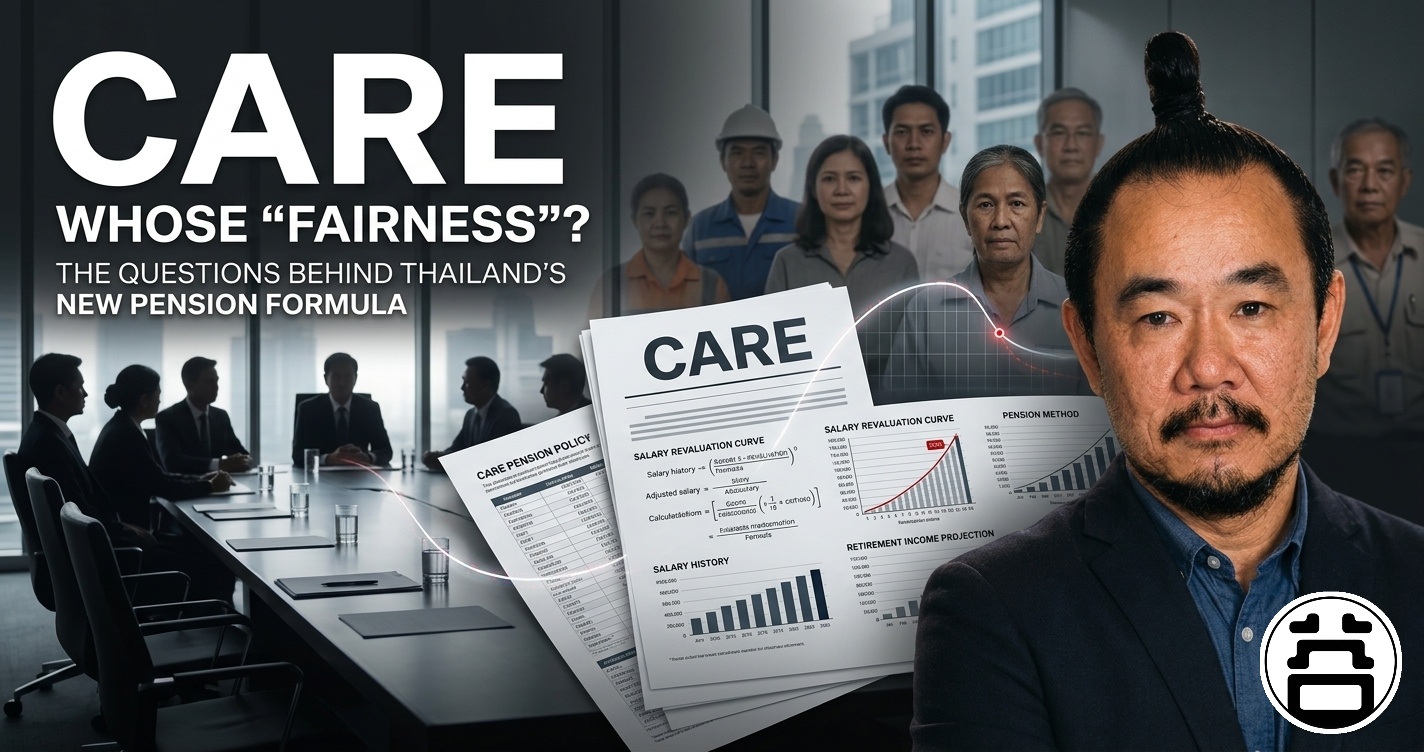
📋 From "Formula" to "Power Over Pension Payments"
On 14 July 2026, Thailand's Cabinet approved in principle a draft ministerial regulation changing how old-age pensions are calculated -- from averaging an insured worker's final 60 months of wages to instead taking wages across their entire contribution history, revaluing them to present-day money, and averaging under the CARE (Career Average Revalued Earnings) method. The government describes this as a move toward fairness, reduced inequality, a truer reflection of a lifetime of contributions, and a more sustainable fund.
This issue shouldn't be reduced to a debate over whether CARE is a good or bad mathematical formula. Once a formula is applied to real workers' pensions, it stops being an equation in a textbook. It becomes the amount of money a person will actually receive every month after retiring -- money that may need to support 20 to 30 years of life.
So the public has every right to ask: Who designed the formula? What assumptions did it use? What index was chosen to revalue decades of past wages, and who chose it? Was it tested against real insured-worker data? Which groups gain, and which groups lose? These aren't political questions. They're basic questions of transparency.
👤 Should "Academics" Face Less Scrutiny Than Officials?
Multiple Thai news reports confirm that Assoc. Prof. Anusorn Thammajai formerly chaired the Social Security Office's ad hoc subcommittee tasked with studying and revising the pension calculation formula for Section 33 and Section 39 insured persons -- the exact body that studied and designed the CARE formula.
Referring to someone in this position with the single word "academic" may leave the public without the full picture of their role in the policy process. The issue isn't whether he has academic expertise, nor whether he has the right to express an opinion -- of course he does. But the public equally has the right to know what role the person explaining the formula's merits actually played in designing it.
❓ Question 1 — Is CARE About "Sustainability," or Shifting Risk from the Fund to Workers?
The government has been clear that CARE aims at fairness and fund sustainability. No one disputes that the fund needs to be sustainable. But why must "fund sustainability" translate specifically into changing how retirees' benefits are calculated? If the underlying problem is fund sustainability, the public has the right to see every alternative considered, not just the one that changes the pension formula:
- Improving investment returns and fund management efficiency
- Reviewing the wage ceiling and restructuring contributions
- Expanding the contributor base and reducing administrative costs
- Or other measures that don't reduce the benefits of people nearing retirement
Has the government compared every option for the public to see? Or, in the end, was changing the formula simply the easiest path -- one then labeled "fairness"?
❓ Question 2 — Does "Revaluing" Really Settle the Matter?
CARE's key defense is that it doesn't crudely average historical wages -- it revalues past wages to present-day money first. That's a fair point: CARE isn't simply adding up someone's first paycheck and dividing. But the more important question is: revalued using what? The moment the government picks a revaluation index, a new question follows immediately -- what does that index actually track?
Not just "we revalued it," but "revalued using which figures, and how much would the outcome change if different figures were used?" This is information the public should see laid out plainly -- not hidden behind the word "fair."
Inflation? Wage growth? Labor productivity? Average insured-worker income? Cost of living? These are not the same thing, and they don't move at the same rate -- the cost of living for working people doesn't track every product price, wage growth doesn't match inflation one-for-one, and real working lives don't move in the straight lines a mathematical model assumes.
❓ Question 3 — If CARE Is Really Better, Why Not Open the Raw Data?
This is the biggest question of all. If CARE genuinely creates more fairness, there's no reason to fear publishing comparison tables. Take real insured-worker data, run the test, and show:
- What do people with consistently low wages throughout their career receive?
- What do people whose wages rose sharply near the end of their career receive?
- What do people who moved from Section 33 to Section 39 receive?
- What do people whose income spiked in their final 5-10 working years receive?
- What do people who started on low wages 20-30 years ago receive?
- How many baht per month, exactly, separates the old formula from CARE?
Not just "CARE is fairer" -- but fairer how, and who actually benefits from that fairness?
⚖️ Why Take "Best 60" Off the Table?
A number of insured workers have proposed "Best 60 Months" -- using the 60 highest-earning months as the calculation base. The government and academics may disagree with that approach. But why not put every formula on the same table? CARE vs. the old formula vs. Best 60 -- run all three against real insured-worker data, and let the public see exactly who gets what under each. If CARE is genuinely better, let it win on the numbers. It shouldn't need to win on the word "academic," or "international standard."
❓ Question 4 — Is "Fairness" Without Verifiable Numbers Just a Slogan?
"Fair" is a word that sounds good. But when it comes to pensions, fairness has to translate into baht. Insured workers can't pay their electricity bill with the word "fair," or buy groceries with the word "sustainable." After retirement, what they need is an actual pension. So if the government says CARE is fair, the answer the public actually needs is: "How much will I receive?"
⏳ A 5-Year "Compensation" Period Still Raises Questions
The government says there's a transition measure for people who begin receiving pensions in the first five years after the new formula takes effect: if CARE pays less than the old formula would have, the gap is compensated on a sliding scale, from 100% in year one down to 20% in year five. That sounds like a safeguard -- but it immediately raises the question: what happens after year five? Once the compensation tapers off entirely, who absorbs the remaining gap? This isn't a question that should be waved away with the phrase "transition period" -- a person's retirement doesn't have a 5-year transition. They still need to eat, live, and cover their cost of living for decades more.
🔍 From "The Academic" Back to "The Public"
Society shouldn't fall into the trap of "an academic said it, so it must be true" -- academics disagree with each other too, the same way economists, actuaries, lawyers, labor advocates, and insured workers themselves can hold different views. Expertise doesn't place anyone above scrutiny. If anything, the more expertise someone has, the more policy-making power they hold, and the more of a role they played in designing the formula, the more they should be open to public scrutiny -- that's a basic principle of public policy.
📝 Conclusion: Don't Let "Academic" Become a Shield
Questioning CARE isn't opposing academia. On the contrary, questioning is the heart of academic inquiry. If CARE is correct, let it be checked. If it's fair, let it be compared. If it's sustainable, open the financial model. And if it's better than Best 60, put the numbers side by side in front of the public. In the end, the people who have to live with this formula's results aren't academics, ministers, or committee members -- they're the working people who pay into social security every single month.
So the question isn't "is CARE a formula that academics say is good?" The question the public should ask is "good for whom?" And if the answer is "good for insured workers," there's no reason not to open every number for the public to judge for themselves -- because pension money belongs to working people, not to the government, and fairness shouldn't require anyone's permission.
🧮 Calculate CARE's impact on your pension
Dr. Boon's (No. 2) own pension calculator — free to use, no unnecessary sign-up required
🧮 Calculate the impact now → 📋 Read the full 7+1 policy platform →