When a Government Tool
Changes Context: Who Is Accountable?
Today, a citizen can access government information with a phone and a few taps. A "link" may look like nothing more than a web address. For a government agency, however, a link can carry much more weight.
📍 From a Public Information Tool to a Question of Neutrality
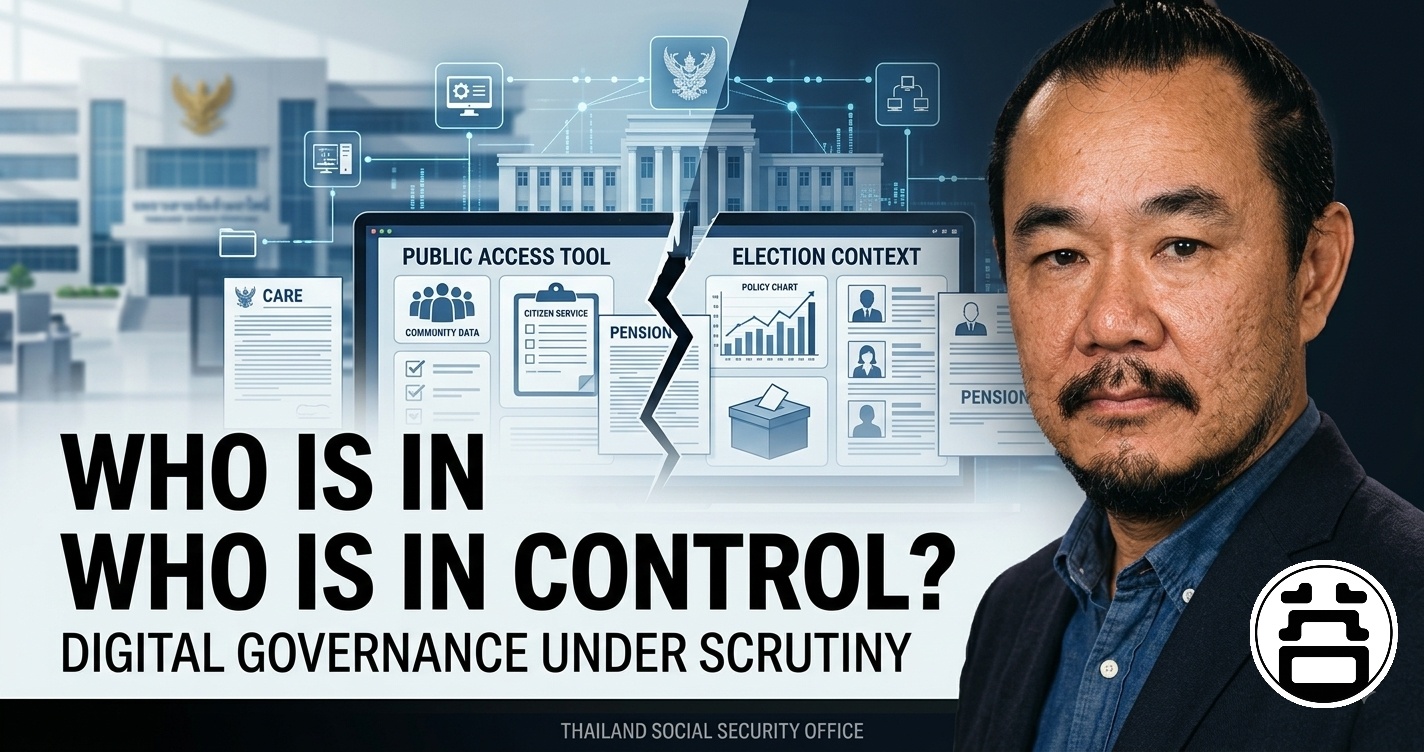
During the period when the Social Security Office was promoting and gathering public feedback on changes to the old-age pension formula, it publicized an online channel where insured workers could test pension calculations under the CARE approach — through official statements and coverage across multiple Thai news outlets.
So when the context of that channel later changes during an election period, the question should not simply be:
The bigger question is:
That is a governance question. And it matters far more than the website itself.
🔍 What Does a Website Name Actually Tell Us?
Most internet users do not think about how domain names work. Seeing "sso" in a web address can easily create the impression that a site belongs to the Social Security Office. Technically, however, a website address is not proof that a site is operated by a government agency — the presence of "sso" in a domain does not, by itself, make the site an official government website, and a non-government top-level domain is not the same thing as Thailand's official .go.th.
There are therefore two separate questions:
| Question | Why it's different |
|---|---|
| Who owns or controls the website? | A question of ownership and technical control |
| In what context did the government previously direct people to that website? | A question of the government's own communication responsibility |
These are not the same question. What can be examined is the public record: during communications about CARE, this channel was presented as a way for insured workers to test pension calculations, including references made through media and government-related communication channels.
⚖️ The Real Issue Isn't the Website — It's the Credibility Borrowed from Government Context
Two things need to be kept separate. First, private individuals and organizations have the right to create websites and publish information — that is normal in a democratic society. People should be free, within the law, to build websites, create calculation tools, and publish policy proposals.
The second issue is different. It concerns what happens when a government agency has previously directed the public to that channel in the context of public information. When the context changes, has the government agency done enough to address the public understanding created by its earlier communication? That is the heart of the issue. Public trust does not come from a website alone — it also comes from the context in which that website was presented, and when that context involves the state, the state's own responsibility deserves scrutiny as well.
🏛️ Digital Governance Is About More Than Cybersecurity
When people hear "digital governance," they often think about personal data, cybersecurity, or protecting systems from attack. But digital governance in government is much broader than that. It also means asking: who owns the data? Who controls the system? Who has the authority to change its content? How are government-related digital resources allowed to be used? Can citizens clearly tell what comes from the government and what comes from a private operator? And, most importantly, when an election is approaching, how is the neutrality of those information channels protected?
These are standards that should apply to government agencies. They should not be treated like ordinary websites.
❓ 7 Questions the Public Deserves Verifiable Answers To
This should not end with citizens arguing over who owns a website. The more important question is what governance and oversight the Social Security Office had in place from the beginning. At a minimum, the public should be able to get clear, verifiable answers to these questions:
- Who developed and maintained the tool?
- Did the government agency have any legal or contractual relationship with the system operator?
- Who controlled the domain, the system, and the database?
- How was user data stored, and who could access it?
- Were there rules governing the use of the Social Security Office's name, marks, or identity?
- When the election context emerged, was any neutrality risk assessment carried out?
- If citizens could still reasonably believe the site was a government channel, what steps did SSO take to prevent or correct that misunderstanding?
These questions are not accusations. They are basic accountability questions for an agency responsible for funds and benefits that affect millions of people.
🎯 Neutrality Matters More Than Who Wins the SEO Race
In an election, candidates are free to build websites, make videos, work on SEO, buy advertising, and communicate with voters — that is normal competition. But a government agency should not, intentionally or unintentionally, become a source of advantage for one participant over another.
So this is not really about "who is better at building websites." It is about "has the state created conditions in which everyone can compete fairly?" If a channel once presented to citizens in a government-information context can later become connected to campaign communication without clear explanation, oversight, or safeguards against confusion, then questions about neutrality are inevitable.
💡 If Everything Is Proper, Transparency Should Be Easy
This may be the simplest question of all. If everything was done according to the rules, if no government resources were used to create an advantage for anyone, if no citizen data was used improperly, and if there was no relationship creating a conflict of interest, then there should be no reason the government agency cannot disclose the relevant facts to the public.
Transparency does not weaken public trust. Quite the opposite — transparency is what builds it.
📝 Summary
The closer the election, the greater the need for transparency. This becomes even more important as the Social Security Office moves through the period surrounding the Social Security Board election — the Board is not a minor institution, and its decisions affect the direction of the social security system, contributions, benefits, and funds that matter to millions of insured people. So the public should demand more than simply "hold the election." It should also demand "hold an election that is fair, transparent, and open to scrutiny." Fairness does not begin on election day — it begins the moment the state starts communicating information to the public.
🧮 Calculate CARE's impact on your pension here
Dr. Boon's (No. 2) own pension calculator — free to use, no unnecessary sign-up required
🧮 Calculate the impact now → 📋 Read the full 7+1 policy platform →